That's right! The entire male staff, plus Shoshana, has moved! Enjoy Common Good Books' slicked back new blog at commongoodbooks.tumblr.com.
It's hard to say what it is about poetry that invites amateurs to the plate. Outside of a contest, I mean. Most people, for instance, don't assume they're fit to fly a plane or run 23 miles, without practice. Then again, most people wouldn't think to compare poetry and aviation. For one thing, the odds of dying on a plane are less than one in a million, while those of dying a little each day one spends on poetry's as sure as rain in April, as they say. It's become something of a right of passage, limning lines of verse to those you love or, at least, smelled once at some point in junior high and--if fate has vehemently saved for you a life of romantic incredulity--even up through college; a kind of youth-fueled task on par with playing catch or learning how to build a fire. You don't have to be an expert, in other words, just be able to look up around the fire someone else knew how to start and confidently roll your eyes when asked if you can believe "that game" the other night. You can and you can't. I mean, how hard is it to catch a pop-up in left field? That all depends, you think, on where left field is.
The odd thing, though, apart from the fact that a man could watch his only son kick a baseball in the grass in order not to have to throw it, call it good and move on then to shaving, is that poetry, unlike the major leagues, maintains an air of apprenticeship; holds dear its naivete, if not the damn ball. "Everyone's a poet!" Not a motto, quite. At least not until it becomes socially acceptable to shout "Thank God It's Recycling Day!" up and down the halls of one's workplace. I couldn't say who coined the phrase, not jovially, in any case (one can hear Plato lamenting an afflictive rise of poets and distortedly asperse that "everyone's a poet," like sad Eeyore, glancing sideways at his house made out of sticks, before knocking back another shot of ouzo), but everyone from Patricia Smith, who in the recently released Passwords Primeval: 20 American Poets in their Own Words says, "Writing is our second throat. The only difference between someone who doesn't write and me is something in my life caused that throat to click open," to your average 3rd grade arts crawl organizer seems drawn to the idea, if not the reality.
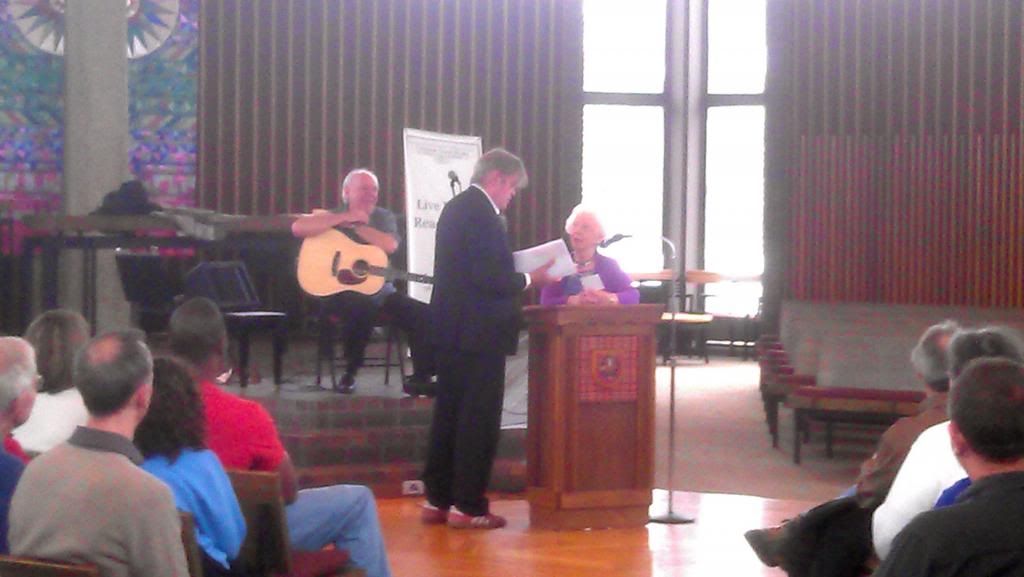
Until recently, I fell into the camp of those who... how can I put this... sort of doubt that "everyone's" a poet. Children five and under, sure. You get to be "poets," and eat free on Monday nights at participating family restaurants. But I am, or was, afraid that anyone capable of holding pen to paper and, at the very least, acknowledging that, just because you can rhyme love with dove and heart with lark, doesn't mean you should, isn't too free to compare themselves to Plath just for delineating journal entries into anapestic trimeter. So then we announce this contest, to which the prefix "amateur" was, I thought, pretty clearly appended, and what happens? People, normal people; people you might well mistake for teachers, students, bloodline relatives, etc., start sending us these works of art. Unpublished works of art, perhaps, but artworks nonetheless. And anyway, long story short, 12 poems were selected, hung from banners like declarations of previous hockey championships, and read before a wildly attentive audience. And now they're up online.
"The poet is an imitator," Plato said. Well, actually, he said "the tragic poet is an imitator," but why kick a dead horse/state the obvious? The truth is we're all imitators. Framing selves on facebook, professing love or, worse, disgust, on cell-phones for the benefit of passers by, and all the while pretending not or fatally missing one's chance to care. Poets may be lots of things--lazy, broke, covered in hair--but few are truly apathetic. "Amateur" at least connotes an interest or attempt; an unfrenetic answer to the already confusing call for audience engagement, tempered by a dash of reverence like a whiskey watered down with Coke. Deference and humility should speak to us of courage, not its opposite. Even Junot Diaz said ambivalence, not confidence, is what startles his work to life; the challenge of the void most writers face each time they write, leaving brainless bravado on the field, where it almost certainly belongs.
Helene Wecker talks to Colin about writing like a golem and finding truth in fiction
At the beginning of our conversation, Helene and I discovered that we both grew up in the fictional-sounding small town of Libertyville, IL. I asked Helene if she recalled the candy store, Some Other Nuts, where as a child I was regularly chastised for buying candy cigarettes and Helene, turns out, got her fill of jalapeno jellybeans. From there our conversation turned to similarities between people and creatures in her new novel, The Golem and the Jinni. Meet Helene in person on June 20th at 7:00 p.m. at Common Good Books.
CGB: Both Chava and
Ahmad, after landing/being set free in Manhattan, have the good fortune of
quickly meeting humans concerned with their wellbeing, or at least their social
lives, as they’re instructed to behave like members of society instead of
mystical creatures. What proved more challenging: imagining the behavior of a
jinni or a golem, or a typical New Yorker?
HW: (Laughs) I think
it was more challenging to create the golem and the jinni because they had to
be that mix of outlandish fantastical and
typical New Yorker. In their bewilderment they are slightly typical New
Yorkers. Certainly as they’re starting out and slowly learning the ways of the
city. It’s funny you say that because I’m thinking now about when I moved to
New York, and that first two or three months of just learning how the crowds
flow, what platform you need to be on in the subway. You could always identify
the tourists by the way they were walking, their speed, how they went through a
turnstyle. I went back to New York a couple months ago and I was smiling at people,
and people were looking at me like Why
are you smiling at me? I’ve got that sort of suburban Hi, how are you? thing, and everyone else is like Who the hell are you? But to get back to
your question, I think it was harder to
create the golem and the jinni because there were so many elements that went
into them, and having to square them with their surroundings and think about
what would be new to them. Not just new to them in terms of the city but not
knowing what people were like.
What’s so interesting
about setting the novel in New York at its peak of immigration is that everyone,
to some extent's, an “other.” Chava and Ahmad, in fact, are fundamentally alike
in their otherness. What about the outsider attracts you as a starting point?
I’d always felt
slightly other growing up Jewish in a small town, which I realize is about as
“slightly” other as you can possibly get. But feeling just a little different. Also, growing up reading a lot of science
fiction and fantasy, and that making me the weird kid. But a lot of it was
connected to the similarities I saw between my family’s history and my
husband’s family’s history. We’re both the children of immigrants and
grandchildren of immigrants. It was a long time before I realized that not
everybody’s grandparents had accents. I thought grandparents had to have
accents, and so I would meet other kids’ grandparents who had come from the Midwest
and that really weirded me out. That off-kilter perspective on being American
with a history from somewhere else; that feeling like something else is the
normal and you’re one or two degrees off has always interested me. And looking
at our family histories and noticing the overlap of issues of language and
culture and all that “stranger in a strange land” sort of stuff--seeing that as
a commonality between the Jewish and Arab-American experiences in America
fascinated me.
How did that
idea or image of otherness change as you switched from the point of view of a
human to a golem?
There are
different takes on the experience of coming to America in the novel, different
psychological baggages. I think maybe it comes down to two different emotional
flavors I ended up seeing. One was coming to America with the forward looking
hope of making a new start, and the other being the bitter feeling of coming to
America and feeling like you’re escaping something or you’ve been pushed into
it. And different characters in the book fall at different places on these
spectra. Of course, it doesn’t mean they’re either one or the other but some
combination of both. There’s hope as well as grief in any immigrant experience.
For characters in the book like Saleh it’s a new beginning, but it’s a
beginning that he thinks is going to be a death he’s galloping toward. And in
as sort of bleak a method as possible, he wants to die. But he doesn’t want to
kill himself; he thinks America is going to do that for him. And then on the
other hand you have all the immigrants in the Hebrew sheltering house for whom
this is a new start.
It’s interesting
to hear you relate your personal experience to the novel’s larger themes. When
I first picked up the book, I assumed it was a YA novel, based on its inclusion
of the supernatural. And yet, as it’s been said and shown, the people who are
actually reading YA books steeped in fantasy are not necessarily young adults.
Your life prior to writing the novel suggests a kind of ownership with the
material, but did you feel a certain freedom to explore the world this book
creates because of the success of late of books like Twilight and The Hunger Games?
When I first
started the book, my very first vision was that it was a short story I was
going to write before getting back to what I was really working on. And then I
thought maybe it was a novella. And then there was a point where I thought
maybe it was a YA novel, because it was relatively short and I thought, I’ll try to write for a younger audience.
I had no idea what that meant back then—this was like seven years ago—and then
it became clear a month or two after I started that this was going to be a big
novel. And at that point I thought it probably wasn’t a YA book, partly because
I wasn’t very well read in YA at the time. And seven years ago… was Twilight even out then?
If so, it wasn’t
TWILIGHT, yet.
There was Harry Potter. And it didn’t feel like Harry Potter to me. And YA hadn’t
blossomed into the crazy huge movement that it is now. And I was writing in an
MFA setting at Columbia, which might have dictated in my mind what it was going
to turn into. But I always kept in mind that I wanted it to be something that
could be read down to a teenage level. Not a ton of sex, not a ton of, I don’t
know, deep darkness, although YA is so much deeper and darker than a lot of
fiction right now that I don’t know what that would have meant. This is the
sort of book I would have completely glommed onto when I was 15-16 years old,
and I wanted a teenager to be able to read it because that is such an awesome
reading age, when you can give yourself over to a book in a way that feels a
lot purer than when I read books now and think, Well, that’s a very well written sentence! But an Oh my gosh, my soul is being pulled out
through my eyes! sort of experience of reading a book. I’m hearing that
people are giving it to their nieces or nephews and that just thrills me.
As you say, it’s
a big book, in part, because it contains so much research about New York at the
turn of the century. How does having rather unlimited access to information
impose on or inspire your writing process?
It’s funny, the
research killed a lot of good story ideas, but I think it generated just as
many. So it became a symbiotic process. For example, I made the golem and the
jinni so that they didn’t sleep, thinking that was a cool way for the golem, at
least, to explore the city. And then, I don’t remember where I read it, but through
some offhand reference I read that “Of course, women didn’t walk alone after
dark,” and I was like, Oh my God, what am
I gonna have her do? She’s just gonna sit in her room all day! She’s gonna go
nuts! And then I thought, Wait, she’s
gonna sit in her room all day and go nuts… that’s gonna be awesome! It
became the impetus for her and the jinni to go out walking together. And I
thought that maybe they would have a walking date once a week. And as soon as I
latched onto that set up the structure for the middle part of the novel and
their relationship was sort of organized around these weekly visits. So I would
get an idea and the research would either feed it or kill it, but in the
process I’d find something out that would contribute somewhere else. It’s
funny, I think about writing something contemporary now and I wonder where
would I get my ideas. Am I just gonna make stuff up?
My last question
is a bit self-serving, but I’ve always thought of Libertyville as the perfect
title for a future Garrison Keillor novel. Say you were assigned to write a novel
in the Lake Wobegon series titled Libertyville.
Where might you go with that?
What immediately
comes to mind is… remember Main Street in Libertyville, where Some Other Nuts
was? All of those businesses--and I don’t know how much of this is still true
because so much has changed, but certainly when I was growing up--they were family
businesses, and so many had been around for years, sitting on that street,
accruing history, and the families all knew each other, so I think it would be
a multi-generational, interlocking love/hate, revenge book, involving all the
families that owned stores on Main Street.
Oh, that’s
great. You could even have a conflict with the newer, corporate businesses.
Yea, like everyone
hates the Honda dealership, because they have motorcycles going up and down the
street all day. You know something funny? I grew up in Libertyville, now I live
in Pleasanton.
(Laughs) The
name Libertyville sounds made up. I’m always having to convince people I came
from somewhere.
It does! I went
through Minneapolis, Seattle, New York and finally came full circle.
The other day at Anderson's Bookshop, in Downers Grove, IL, I came across a t-shirt that said "Don't judge a book by its movie," just next to a shirt that said "My book club can drink you book club under the table." The first shirt made me laugh, the second made me smile and nod in recognition. "Damn straight," I thought. "Enough with the jokes."
Ever since the ads for The Great Gatsby started showing up on TV and in magazines, it seems that readers too have had enough of their own inexperience. I can't say what accounts exactly for the change--the hit strewn, hip-hop soundtrack? Director Baz Lurhmann's first name?--but watching Leonardo DiCaprio buzz around in a Rolls-Royce, as if speeding off with any chance of making our own first impressions of Jay Gatsby's character, impelled in these last weeks a not surprising surge in sales of Scott Fitzgerald's masterpiece. And yet, I'm still surprised. Or gladdened. Reaching for a book packed tight inside the canon is hard work. What's the point, after all, if the book's contents are going to be projected at us in the form of images and poster art and references at parties made to dimly draw the line between the well reads and the Luddites in a matter of time, anyway? And yet, those who have saddled up or walked past our F. Scott Fitz display and asked to see The Great Gatsby, without a hint of sarcasm, insist the movie less inspired them to finally read the book than, like some portent of a future separating nuts from bolts, rattled and reminded them how necessary words are in a scream of lights and sound effects.
And so I saw the film. And not out of some masochistic impulse to inflict pain on myself, either! Nor a desire to back up my being right with specific examples, but, in truth, because I'd mixed up the release date of Star Trek Into Darkness with that of Pain & Gain. And without going into detail I'll just say some stories hit too close to home.
Now when I say "I saw the film" I mean insofar as possible. Today, for example, I "made lunch," by which I mean I opened up a jar of peanut butter and kept on dialing the number for Pizza Luce. I bought a ticket. I sat down. I sat through innumerable advertisements for Coke, The National Guard, Superman Returns, Again, and, as far as I could tell, some combination of all three, which seemed to suggest that if you drink Coke and join The National Guard you could win tickets to see Superman. And yet, I spent the movie formulating one of my personal all time best grocery lists ever. Including, but not limited to, bread and jam. Why? Because I could. As I said to my companion dressed regrettably as Spock, the film is a connect-the-dots of images and plot points, in the most sportive sense of that word; or, better yet, a kind of Mad Libs but with spaces where the parts of speech that help to form a sentence go, while words like "poop" and "dingle flap" lay visibly in wait to give our wackiest, most devastating readings of the novel shape. I didn't have to "read" or pay attention to the film to grasp its meaning, but check on it from time to time like something cooking in the oven... from what I understand. Instead, as if adding swaths of color to a paint by numbers, I filled in the pretty faces and car chases with the language of the novel, or at least my memory of it, that its sensations, and so its plot, depend on and spring from, as 3-D strings of beads and effervescent champagne pearls failed wildly to translate, or distract me from, words anyway. Or what I imagine was 3-D had I not arrived already wearing Lt. Geordi La Forge's visor. What, I wondered, would anyone who hadn't read the book make of such placeholders, which on their own resembled a kaleidoscopic disarray of images devoid of sense, let alone substance. Perhaps Baz Lurhman's vision was in bringing not the words but world of The Great Gatsby to life, in all of its material splendor. And come to think of it I suppose that's the point of any film, no less a summer blockbuster. Which still doesn't make sense of why a story whose eponymous protagonist throws all his weight in fashioning a narrative from life would prompt a writer or director to regard merely its surface.
Lest you think I'm suggesting that movies and books are incompatible, let me be clear and say there's something, frankly, impossible about adapting books to screen. Not in the act but outcome. Just as there are plenty of good stories that can't and shouldn't be told literally. Regardless of how accurate or true to x, y, z, one's reading is, to some extent, oblivious of such concerns as plot and temporality. We read stories in spurts and study characters like mirrors, conflating and creating a persona, if not an identity, as David Foster Wallace said, that we may come to recognize as ours; our lives, in other words, are recklessly entwined with those we read about, like bowling balls hurled sideways at the pins seven lanes over. No wonder then, especially in talk of books like Gatsby, whose loosely ornate sentences oppose the skyscraping opulence Jay Gatsby's world demands, like diamonds scattered brazenly across a four-lane highway, we say "my," as in "my Gatsby"; the one that several customers of late at some point lost and now want back, lest it be taken from them, this time, in the form of a Brooks Brothers ad for menswear. Gatsby is a book about impermanence,"a conflict of spirituality set against the web of our commercial life," as Edwin Clark wrote in The New York Times, and that was back in 1925! To reduce its smoldering ash and firmament to a $200,000 headband is to rebuild Babel's Tower, and suggests either a careless apprehension of the novel as a starting point or hilarious misunderstanding of the function of metaphor.
To put it in terms then Fitzgerald himself might have appreciated, not having read Gatsby is like living in St. Paul and not having been to Chicago. It's always there and always will be, so why bother? What's the rush? And while it's pretty clear that I'm defending the first book I read as an adult and loved the way I've come to love all books that I don't "get," that's just my point: if you don't try, someone else will on your behalf and spit it back to you like a bird. And who wants scraps of chewed up paper spit out in their mouth? It's a rhetorical question, mam. "Don't judge a book by its movie." Or its promo tie-in cover, for that matter. That is, unless you have no plans to read the book. In which case, I can think of worse things to have sitting out on your coffee table than Leonardo DiCaprio's smug grin and starlit eyes. But don't get me started on that.
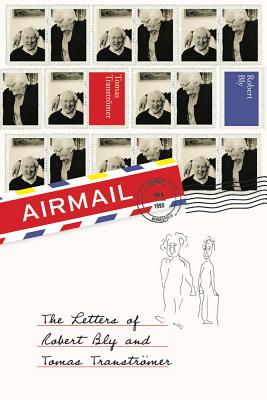
A few weeks back I wrote about the poet Christian Wiman's meditation on belief, and once again, I find myself drawn to a book about a poet that's not poetry. Actually, it's two poets. And, truth be told, Airmail is full of poems sent back and forth between said poets, Robert Bly and Tomas Transtromer. That is, when they're not talking about the 1964 election, or the death of Randall Jarrell, or the birth of a daughter. By the way, why is it that we caution ourselves from poets with the title, while novelists and memoirists and famous chefs stay, simply, "authors"? Is it the worry that a poet might actually open the door of a moving vehicle while a novelist, at worst, might base a character's penchant for cursing on your road rage? (One good for nothing poet makes a joke about free will that doesn't play and has to ruin it for everybody.) Hmm? Oh, nothing. I thought you said something. Ha. Funny.
You could look at Airmail as a collection of poems with extensive background notes, but it is, in fact, or in guise, a collection of letters; the letters of two internationally acclaimed poets who after, by chance, checking out each others' books at the same time (Bly coming home from the University of Minnesota library with a copy of Transtromer's The Half-Finished Heaven in hand only to find a letter waiting for him from Transtromer himself) started up a correspondence that would last for nearly thirty years. With more than 290 letters in tow, Airmail more than represents the baggage of both poets' concerns, from the war in Vietnam--which Bly rallied against in the poems that he wrote and those he published in his magazine, The Sixties, and in co-founding American Writers against the Vietnam War--to the daily struggles of living a life that affords time to write as well as eat, pay bills, and travel. Which isn't to say that Airmail documents a time when either Bly or Transtromer were nobodies. Though the poets' friendship took off before Bly won the National Book Award, and nearly 50 years before Transtromer won the Nobel Prize, becoming something of a household name, both poets were well established in their respective countries. Thanks, in no small part, to Bly and Transtromer's concomitant commitment to translating each others' work, the ins and outs of which are on display and irresistible for anyone interested in the intricacies of a poem's, much less a translation's, evolution, Transtromer's is now a face of poetry in America, just as Bly, presumably, is recognized in Sweden.
So, that's the big idea. But as in all art it's the little ones that do and should take shape. As Transtromer writes, referring to the lack thereof in several of his contemporaries' politically astute polemics: "They drape themselves in an attitude instead of giving form." And not surprisingly, the form of these letters--indeed, the form of letters, period, or semicolon, depending--is what gives readers the sense that we are in on the conversation. And not in some scandalous, drug-addled, out of depth look into Robert Bly's sock drawer sort of way, but as if coming across ideas and information for the first time: conversations unrecorded, works in progress, words unmeant and pardoned. A pensive spontaneity seems to be what Transtromer and Bly had in mind when they began their correspondence; a practice that with luck and time might grant their poems, and their lives as poets, a kind of validation no reward could supplant; that of close reading and acceptance, in the sense of being given, not just baited. "What makes translating SNOWFALL so worthwhile," Transtromer writes, "is that the poem will strike Swedes as completely natural--a good reader knows that this isn't an exotic product by some American but I have experienced this mystery for myself." Likewise, as Thomas R. Smith notes in the book's introduction, Transtromer's letters were as sparsely edited as possible so that we "may enjoy [them] as Bly first did." (Just now, for instance, I could have sprung the label "editor" on Thomas R. Smith's name, but did I? No. Because no one thinks Thomas R. Smith is capable of sleeping with your best friend and, literally, forgetting all about it.)
Now me, I don't even answer the door unless someone is pressing record. And though a reader has to wonder whether two of the world's most famous writers saw their exchange as a potential intellectual artifact, as a certain, recent publication seems wont to assert, all signs point to, if not the opposite, a general disinterest in embellishment and voyeurism in favor of a drawing back, again, in terms of shedding their personas and in effort to delimit and refortify their work (i.e., at no point does Transtromer take advantage of the opportunity to ask Bly why he thinks he's the "only poet worth reading in North America" or "what gives [his] hair such volume"). "Other translators give a pale reproduction of the finished poem," writes Transtromer, "but you bring me back to the original experience." Originality is what we addict for in works of art like these; a starting point from which to base what we consider to be easy, though intangible, works of the imagination; plumes of time intensive smoke that slowly rise up from the ashes of experience and go on to shape a writer's legacy, while staying secrets even the most articulate of authors often can't, or won't, explain. We want answers. Damnit! (Eh, just trying it on.) Yet letters, journals, prison scrawls, etc., more than remnants scattered across the literary landscape for posterity, remind us that no book or poem is a relic but a product of exchange. And not a consumer product, either. Ha! There! One for poets! Two for the uncle who didn't order pizza at Thanksgiving and pretend not to be home. But one for poets!