

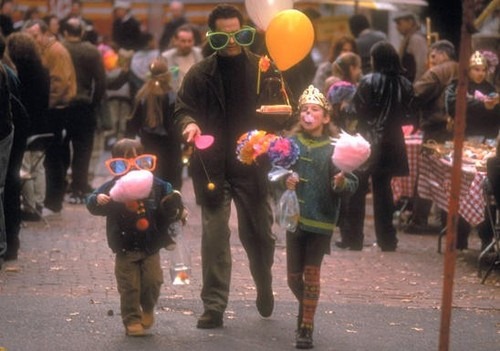
This past weekend I visited New York; a city with a literary history to rival the Twin Cities'. I was sure I'd stumble upon poets slamming in the subways, wordsmiths journaling in Central Park, the ghost of Willa Cather, and a series of earnest, old attic-like bookstores peeking out from every corner, where Tom Hanks could presumably be found shaking his greedily money-filled hands up in the air at the incorrigible success of yet another independent. And I did! Minus Willa Cather's ghost, which was, admittedly, a stretch and most of what happens in the movie You've Got Mail. Most! If you think for a second I didn't jump at the chance to eat cotton candy and play paddleball in silly glasses, you've got a lot to learn about my taste in free time. When you ask Colin McDonald if he wants to ride around in a tiny pretend race-car in the middle of Manhattan, in an obvious effort to look charming and vie for the attention of young women, his only question is "HOW HIGH?" Which is really more of an answer, really.
 In truth, though, what I saw reminded me that books still play an integral, if not flamboyantly apparent, part in American culture. From poems on the F train (courtesy of Graywolf Press' own Jeffrey Yang, I might add) to iPad ads with Steinbeck in the spotlight, books and what books may or may not hold for us are, curiously, everywhere these days, in much the same way that religion masquerades in the form of atheism and Food Network fan sites. Perhaps because, as Adam Phillips writes in Missing Out: In Praise of the Unlived Life, we're encouraged more than ever to know who we are, in reference to what things we have and want, or wish we did. Like the ability to talk about The Grapes of Wrath, for example, if not the memory of having read a single word.
  However shamefully or creepily the white space found in books sneaks up on our everyday, image-filled lives, it is at least as obvious such room to breathe is valued still, especially perhaps in places like New York, where room to breathe is harder to come by than a seat on the subway that doesn't have hair on it. Hot on the trails then of last week's Digital Book World Conference, I want to think the next few days less about how books can compete with electronic books and Twitter and/or why they should or shouldn't, and instead turn my attention to how books, as objects and ideas and, yes, even as the first link in a chain that once complete resembles very much a movie about breasts, are in turns valued and devalued, just as billboards outside subways (like the one shown here up top) make perfectly, contemptuously clear.
  |
| Booksellers at The Strand make international help sign in response to overwhelming number of customers. |

No comments:
Post a Comment